Evidentiary Hearing for Rex v Whatcott “Hate Crime” Trial
Ontario, Canada
Oct. 27 - Nov.3, 2025 and Jan. 29, 2026
Notes from live proceedings via Zoom
by Arthur Schaper, MassResistance
Posted June 1, 2026
Day 1: Oct. 27, 2025
The judge presiding over the evidence hearing, Justice Heather McArthur, was wearing a mask the whole time. She explained that she had two very sick family members at home, and she wanted attendees in the court to mask up or leave if they displayed any symptoms of illness. It was very disconcerting.
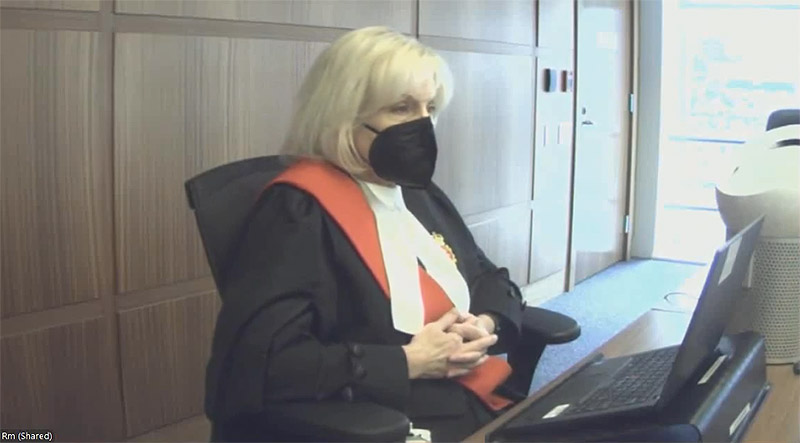 The judge listens to the attorneys give their arguments.
Crown counsel (prosecution) made initial arguments in favor of including Whatcott's Saskatchewan flyers that he distributed in 2001 and 2002 when he was protesting homosexuality issues in the public schools. In 2013, the Supreme Court of Canada ruled that two of those flyers were hate speech, and two others were deemed protected speech. These flyers would supposedly show a pattern of Mr. Whatcott’s inciting hatred against homosexuals. The Crown counsel read the contents those early Whatcott flyers into the public record.
Now, over a decade later, Whatcott will be prosecuted a second time on another flyer he passed out at the Toronto Pride event in 2016 – though he was already declared “not guilty” of hate speech for this flyer in 2021.
The Crown argued for including blog posts and speeches that Whatcott had given after his 2018 arrest about the persecution he was facing just for passing out Gospel tracts in a pride parade.
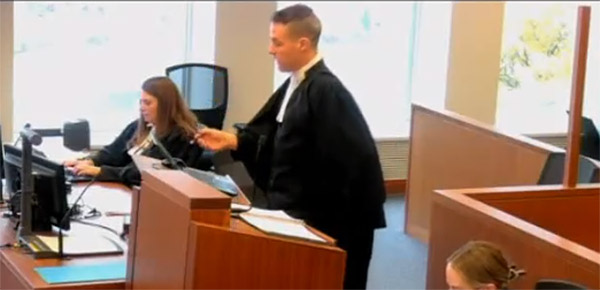 The Crown prosecutor at the hearing.
Defense counsel pointed out that the Canadian criminal code has not provided a clear definition of hate, and that the Crown must prove that the 2016 flyer (and Bill’s blog statements) intended to promote extreme hatred and vilification. The Defense then pointed out that the Crown has to prove that Mr. Whatcott intended to promote hatred against the homosexual population. The defense argued about the differences among terms like animus, detestation, vilification, etc., all to show how challenging this case can be for Crown counsel.
 One of Bill's defense attorneys makes a point to the judge.
Defense attorneys then argued against including the flyers that Whatcott had distributed in Saskatchewan in 2001 and 2002. The discussion revolved around the issue of motive. The flyers from over twenty years ago were denouncing and exposing the LGBT agenda in the schools. The defense attorney went to great lengths to show that these flyers cannot be used to show that Bill Whatcott had a history of inciting hatred against homosexuals. Much energy was expended discussing whether Bill was using terms like “homofascism” as “terms of art” or a “rhetorical trope” rather than expressing earnest hatred against a population.
The Crown tried to justify including the prior flyers and the Supreme Court of Canada case (Saskatchewan (Human Rights Commission) v. Whatcott) to show a pattern of how Bill Whatcott refers to, and thus denigrates, “gay people.”
Day 2: Oct. 28, 2025
Dr. Nick Mulé is a professor at York University in Ontario, Canada (in the School of Gender, Sexuality and Women's Studies). He is the proposed expert witness of Crown counsel. He answered questions to determine his suitability to testify in the trial against Bill Whatcott.
Here’s the posted description of Mulé’s research interests:
Dr. Nick Mulé’s research interests are in the areas of advocacy, social inclusion/exclusion of gender and sexually diverse populations (lesbian, gay, bisexual, transsexual, transgender, two-spirit, genderqueer, intersex, queer, questioning – LGBTQ) in social policy and service provision and the degree of recognition of these populations as distinct communities in cultural, systemic and structural contexts. He also engages in critical analysis of the LGBTQ movement and the development of queer liberation theory.
Again, Mulé (who is clearly homosexual) is the expert witness whom the Crown Counsel wants to rely on to convict Bill Whatcott of inciting hatred.
Mulé's testimony and reports drew on his expertise in “queer liberation theory.”
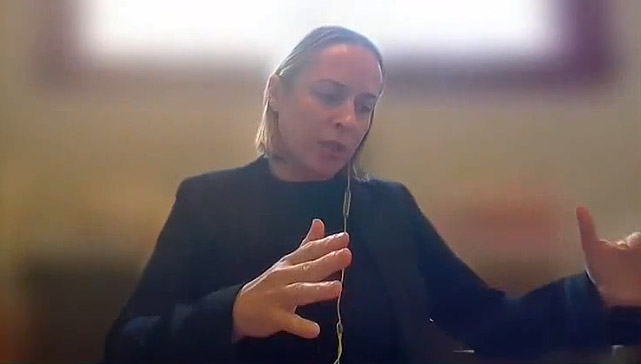
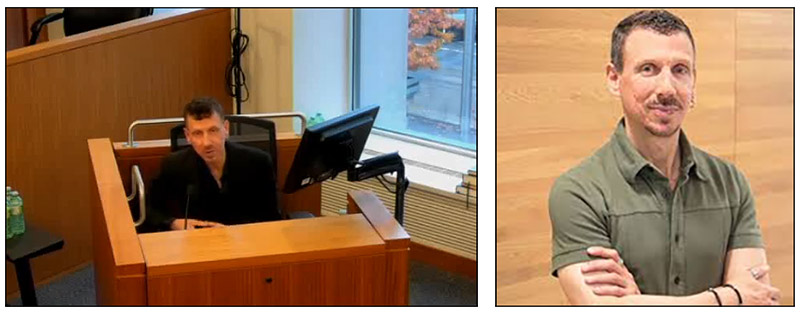 "Professor" Nick Mulé testifying (left) and his photo from the university.
The defense attorney questioned him throughout this day’s hearings. She questioned Mulé about several paraphilic disorders in the DSM. She pointed out in her cross-examination that the diagnostic handbook changed the description of paraphilic disorders (from DSM-4 to DSM-5) to include distress for the individual suffering the disorder and harm to others. “Lack of consent” became a key component of the definitions in the DSM-5.
Mulé found these enhanced qualifications in the DSM stigmatizing for the LGBT “community.” The notion that sexual paraphilias could cause harm, or that any medical association would pathologize such behaviors, was offensive to Mulé.
During the cross-examination, the judge readily admitted that she was unclear about the medical terms, scholastic topics, and contents of the doctor’s research. (This lack of clarity and understanding of the issues should have disqualified the judge from the hearing!)
The defense counsel went over one of Mulé’s papers, titled Progressive LGBTQI movements in a transnational context. The title gives a sense of the academic jargon that Mulé engages in, and what the defense and Crown counsel discussed in this day’s hearing. The main theme of Mulé’s article is “queer liberation theory” Twhich argues for homosexuals and other paraphiliacs living out their “true selves,” irrespective of “heteronormativity” in society.
Mulé also stated that the BDSM community is very much against non-consensual sex. They talked about a lot of sexually perverted issues. The entire session focused on the professor’s perverted academic theories that would make a case against Whatcott.
The defense attorney also pointed out that the expert witness had no expertise in religion or law, which further cast doubt on his credentials to serve as an expert witness in the first place.
Defense wanted to get Mulé’s opinion on a case in which a college student was accused of racial hatred because he was reading a book about the KKK, and the cover offended a student on campus. The judge interrupted that line of questioning because the defense counsel did not provide a copy of the book cover.
Day 3: Oct. 29, 2025
A preliminary discussion between the defense attorney and the judge took place before Prof. Mulé took the stand.
The defense argued that she wanted to surprise the witness with questions about his membership with LGBT groups and other leftist organizations, which were also allied and connected with terrorist groups, particularly the Popular Front for the Liberation of Palestine. The Palestine group has been listed as a terrorist group by a number of countries, including the United States and Canada.
The judge ruled that the Crown counsel could inform the expert witness about the defense’s proposed line of questioning before Mulé took the stand. This ruling deprived the defense of the element of surprise needed to get the gut reaction of the expert witness, without him being able to cover up his biases.
The judge didn’t think that the information about Palestinian terrorist group connections was relevant. She mockingly asked if the defense wanted to make Mulé out to be a terrorist or someone who favors terrorism. In response, the defense counsel explained that she wanted to show that he is so biased (since he shows a different level of scrutiny with different groups) that his expert opinions do not warrant inclusion in the trial. The judge would not allow the defense attorney to do that.
Following this preliminary discussion, the cross-examination of the expert witness took place.
The defense attorney cross-examined Mulé about Whatcott’s 2016 flyer. She also commented on Mulé’s report, in which he had analyzed Whatcott’s flyer. Mulé’s argument was that Whatcott and his flyer were engaging in invidious discrimination and inciting hatred against a targeted group.
The whole cross-examination of the expert witness took about two hours.
The defense attorney questioned the expert witness’s knowledge when he challenged some of the information Whatcott had included about Canadian politicians. Two of the politicians listed in the flyer had committed sex crimes against children. Those same politicians later helped push gay marriage in Canada and the explicit sex-ed curriculum in the province of Ontario. Mulé argued that Whatcott was denigrating the entire “gay community” by pointing out the crimes committed by those politicians.
Mulé also stated that it was discriminatory and wrong for Bill to call homosexuals sinners, because faith institutions have been taking steps to accept homosexuals and transgender individuals as normal. Mulé justified labeling the factual statistics Bill listed on his flyer as discriminatory because lots of sexual behaviors can lead to the outbreak and spread of STDs, in his opinion.
Throughout the questioning, one could tell that Mulé, as an out homosexual and LGBT activist, was merely giving his activist opinion to justify and defend homosexuality. He believes that Whatcott’s flyer was purely hateful for characterizing homosexuals and transgenders as damaged people who need help.
At one point during the questioning, the defense asked about Mulé’s assertions that Whatcott was exaggerating the amount of disease in homosexual populations. She showed that in some cases, Mulé did not provide specific evidence to prove his claims against Whatcott’s flyer. In other cases, the defense showed that Whatcott’s supposed “exaggeration” was a minimal difference in statistics, or based on different sources.
Day 4: Oct. 30, 2025
This day’s session was much shorter. The defense attorney took care of some housekeeping issues, including requesting a later start for the next hearing date because Bill had a medical appointment. The Court granted the request.
The Crown counsel questioned his expert witness to rebut some of the cross-examination from defense counsel. During the re-examination, Mulé acknowledged that no one can be bias-free. He then claimed that because he received training on research and research methodology, he could limit his bias. He talked about positivism and postmodernism as different fields of thought for analyzing data and evidence.
Regarding the cross-examination on paraphilias, the Crown counsel asked if Mulé thought that pedophilia should not be a crime. Mulé responded that children need to be protected from child abuse. But he also advocated for having a compassionate and open mind to understand why individuals become attracted to children.
Mulé explained that Crown counsel from the previous trial had asked him to write a report analyzing Bill Whatcott’s 2016 flyers. Mulé turned in the report in 2019. Defense counsel objected to some of the Crown counsel’s questions because he was bringing up new topics.
Day 5: Nov. 30, 2025
This was the last day of the evidentiary hearing to provide evidence. After this day, the judge would determine what evidence would be presented during the trial, Rex v. Whatcott.
The Crown and defense counsels made their final arguments for inclusion or rejection of disputed evidence for the trial.
The Crown Counsel discussed Whatcott’s 2016 flyer. He argued that Mulé’s expert testimony was necessary to explain why the tropes and images that Whatcott used in that flyer would contribute to inciting hatred toward gay men. The expert witness could also explain how connecting health risks and the spread of disease among homosexuals can contribute to incitement of hatred against homosexuals.
Crown counsel argued that a Toronto jury would not understand all the negative aspects of the tropes used to depict gays, and that they depict them in a negative light. Crown counsel argued that the expert witness is essential to understand the impact of Whatcott’s flyer on the attendees at the pride parade, i.e., that they would incite hatred. Defense counsel argued that the court should reject the expert witness in part because members of the jury might be homosexual, and they would end up being prejudiced against Whatcott. Crown counsel rebuffed this argument because no one will be able to tell if a juror is homosexual.
The Crown counsel insisted that Mulé would be able to keep his admitted biases in check and testify with factual precision how Whatcott’s flyers warning about the dangers of homosexual sex were hateful and would cause harm to the “gay” community.
Defense counsel argued that the expert witness’s testimony is still not necessary. Her argument could be summed up thus: No one needs an expert witness to help them decide if a flyer stirs up hatred towards a certain group or not. Basically, she restated Justice Goldstein’s reasons (in Whatcott’s 2021 trial) for not including the expert witness in the first trial.
She stressed that Mulé demonstrated a pattern of bias and advocacy during the questioning throughout the evidentiary hearing. Such bias would mar his credibility as an expert witness and poison the jury against her client, Bill Whatcott.
During this final day of the hearing, the judge spent more time questioning and arguing with defense counsel. The judge was clearly leaning towards keeping Mulé as an expert witness. She even argued that just because Mulé called certain contents of Whatcott’s flyer discriminatory did not mean that he would be biased.
To end the final day of the hearing, Judge MacArthur informed the Crown and defense counsel that she would have her decision prepared for them in late January 2026 (nearly three months later).
Judge's ruling: Jan. 29, 2026
This day was the final day of the evidentiary hearing to determine which documents and “expert testimony” would be admissible in the Whatcott trial.
The judge ruled to include Bill Whatcott’s flyers from his prior anti-LGBT activism in Saskatchewan in 2001 and 2002. The court would also allow the Supreme Court of Canada's opinion regarding the flyers to be admitted.
All the blog posts that Bill Whatcott had published after he was charged in 2018 would not be included in the trial. The judge reasoned that Whatcott’s remarks about “homofascism” and his other attacks on the LGBT agenda likely sprang from his frustration with being charged with a crime, and not his hatred toward any community.
Finally, the court ruled that the expert witness, Professor Nick Mulé, would be permitted to testify (even though he is an outspoken gay rights activist). The judge deemed that the professor would be able to limit his bias and testify objectively regarding the contents of Bill Whatcott’s flyer distributed at the 2016 Toronto Pride parade.
The next court hearing was set to take place on April 20, 2026, to determine where the trial will take place. The actual trial date was set for May 25, 2026. Whatcot shared with Arthur that the jury trial will last three weeks.


Please help us continue to do our uncompromising work!
Our successes depend on people like you.
Your support will make the difference!