MassResistance Special 10-part Report:
Why LGBT “GSA Clubs” must be banned from all public schools.
Part 9: How Texas banned GSAs statewide
Texas GSA ban is part of a bold, comprehensive parents’ rights law enacted in 2025
Radical pro-LGBT groups got a temporary court injunction in three school districts
But other schools across state have closed down their GSAs
July 31, 2026
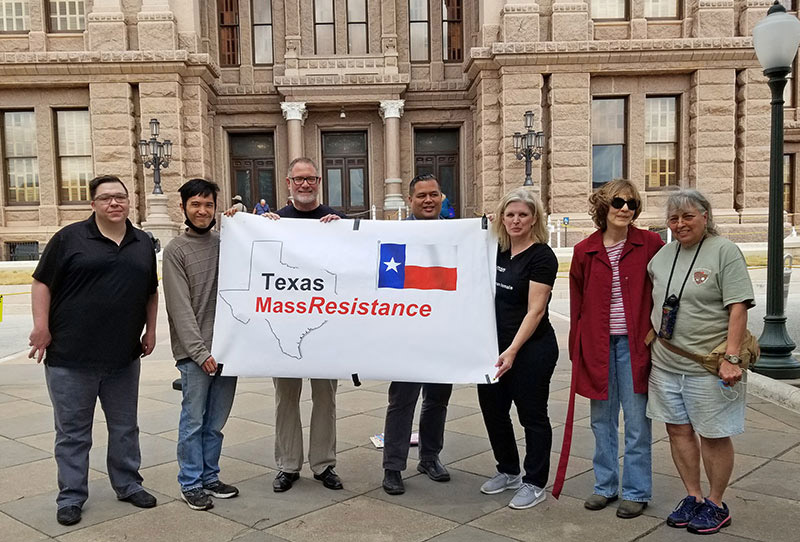 Outside the Texas State Capitol in 2021. For years MassResistance pressured Texas legislators to move forward on parents' rights. They kept stalling. It finally came to fruition last year.
Texas is boldly leading the way and doing the right thing.
In Part 8 we described the legal threats used by the LGBT movement to keep GSA clubs (“Gay Straight Alliance” or “Genders and Sexualities Alliance”) from being blocked in schools. In particular, they invoke the federal Equal Access Act (which we debunked in Part 7).
As a result, state legislatures, local governments, and school districts have been afraid to prohibit GSAs.
But the Texas legislature has now passed a law that outright bans GSAs. And the state is aggressively fighting the LGBT movement’s court challenge in three school districts. (Texas has over 1,200 school districts.)
Texas passes a bold bill
On June 20, 2025, Texas Gov. Greg Abbott signed bill SB 12 into law. It is a comprehensive bill that enacts a bold list of parents’ rights mandates, as well as new reporting requirements, certifications, and directives for all Texas schools.
When it went into effect on September 1, 2025, it gave the Left nightmares.
The major parts of SB 12 include:
- Ban on all GSAs. The law specifically says: “A school district or open-enrollment charter school may not authorize or sponsor a student club based on sexual orientation or gender identity.”
- Requires written permission to join any student club. A school district must require the written consent of a parent or guardian before a student may participate in a student club at the district or school. (Note: We are not sure why this extra bureauracy is necessary now. Requiring permission for all clubs was a tactic by some schools to avoid the legal threat of banning GSAs, but just makes it harder to join them.)
- No LGBT discussion or indoctrination in classes or elsewhere. Prohibits school districts, charter schools, staff, or third parties from providing instruction, guidance, activities, or programming regarding sexual orientation or gender identity across all grades pre-K through 12th. (This is as important as the GSA ban!)
- No DEI in the schools. Schools are prohibited from having any school-wide diversity, equity, and inclusion (DEI) initiatives or activities. School districts are barred from assigning DEI duties to employees or allowing employees, contractors, or volunteers to engage in DEI duties.
- No “social transitioning” of students. School employees are prohibited from aiding or encouraging a student's "social transitioning" (such as using a name or pronouns that differ from the student's legal name or biological sex) without express written parental consent.
- Parental notification of changes to students’ health or “well-being.” Parents must be notified of any changes to mental, emotional, or physical health of their children, and if they are being monitored regarding that. It also prohibits policies that encourage students to keep health information hidden from parents. (Example: Children in an emotional crisis are easily persuaded by school counselors that they are “gay” or “trans.”)
- Strict opt-in for psychological, medical, and health services. Clarifies that explicit, affirmative written consent (which cannot be bundled with other generic signature forms) is required for psychological/psychiatric exams or treatments, biometric data collection, non-routine healthcare/medications, or human sexuality instruction.
- Written consent for surveys and screening. Requires written parental consent prior to administering any well-being questionnaire, survey, check-in, or health screening form.
- Pro-parent school board meeting changes. Local school boards must hold their meetings outside of normal work hours, move the public comments segment to the beginning of the meeting, and have an online comments portal.
- Parental access to child’s school library records: Expands parental record access rights to include tracking all library materials checked out by their child.
- Mandatory posting of course syllabi: Requires districts to post an instructional plan or syllabus for every class on the district website at the start of each semester, and mandates that teachers provide copies to administrators and parents before the semester begins.
Complying with GSA ban
To avoid state compliance penalties or loss of funding, school districts across Texas quickly got to work to follow the law.
Regarding the GSA prohibition, school boards and administrators across Texas moved to formally disband, derecognize, or deny facilities to GSAs, Pride clubs, and similar student organizations.
In many communities, former GSA student leaders shifted their meetings off-campus to local community centers, libraries, or online platforms to maintain support networks outside of the school’s jurisdiction. But that means the clubs are now less influential or effective than when they were official groups inside the schools.
In addition, districts across Texas created a new administrative infrastructure, requiring all students to submit signed parental consent forms before joining any extracurricular club (chess club, robotics, debate, etc.).
LGBT legal groups file a lawsuit and get an injunction for 3 school districts
A few days before the law took effect, a coalition of radical groups filed a federal lawsuit, GSA Network v. Mormath, in the U.S. District Court. The plaintiffs included: GSA Network, Transgender Law Center, ACLU of Texas, Texas American Federation of Teachers, and some individual students and teachers.
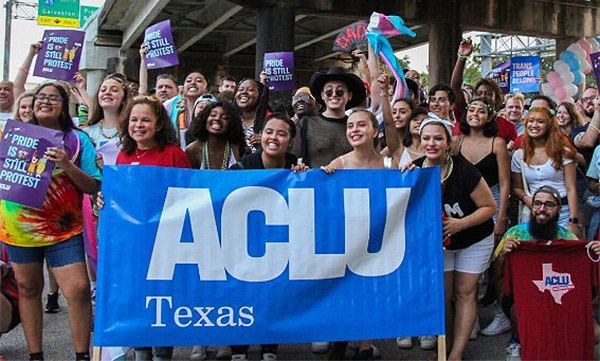 Pushing the agenda. ACLU Texas staff at LGBTQ Pride event. Note their signs: "Pride is still protest." [Photo by aclutx.org]
The plaintiffs’ legal standing allows the lawsuit to apply to only three school districts: Houston ISD, Katy ISD, and Plano ISD.
The lawsuit challenges four parts of SB 12:
- The GSA Ban (Section 27 / Sec. 33.0815(b))
- The Inclusivity/DEI Ban (Section 3)
- The Social Transition Ban (Section 7)
- The “LGBTQ+” Curriculum Ban (Section 24)
(Interestingly, the lawsuit challenges the GSA ban, but it does not challenge the requirement for written parental permission for a student to join any authorized school club. That’s likely something they don’t think they can win.)
What is the basis for their legal challenge? In GSA Network v. Mormath, they use the same basic hackneyed legal arguments that we’ve seen them use everywhere for these kinds of cases.
- The Federal Equal Access Act of 1984: They claim that the law prohibits schools from “discriminating based on content of speech.” But as we’ve outlined, that law does not apply in this situation.
- First Amendment (Free Speech): They claim the state is singling out topics of sexual orientation and gender identity for “targeted suppression.” But in fact, schools and teachers do not have a “free speech” right to present anything imaginable to minor children. (If they want that, they should teach at a college instead.)
- Fourteenth Amendment (Due Process): They argue that restrictions are so vague that it’s impossible for educators to know what conduct or conversations are prohibited. That is all absurd.
In a normal courtroom (i.e., with an unbiased judge) with aggressive and knowledgeable lawyers defending the case, this would be a very difficult lawsuit to win.
The plaintiffs asked for an immediate injunction for the three districts against implementing the challenged sections of SB 12 (including the GSA club ban) while the lawsuit is litigated.
In an upsetting development, the three named school districts declined to defend against the lawsuit. Instead, they filed brief responses taking "no position," which the court treated as a procedural waiver under party-presentation principles. This is not surprising. Those districts likely have leftist school boards and public attorneys who don’t oppose the LGBT agenda in their schools.
Thus, since the injunction request was unopposed, on February 20, 2026, U.S. District Judge Charles R. Eskridge (a Trump appointee) granted the plaintiffs' motion for a preliminary injunction. The injunction is limited to those three districts; it is not statewide.
Texas Attorney General stepping in to defend the case and appeal the injunction
In April, 2026, the Texas Attorney General filed a formal motion to intervene to represent the State of Texas's sovereign interest in defending Senate Bill 12 in the lawsuit. The motion was approved. The AG’s office is now actively leading the defense of the law on the merits as the case proceeds through discovery toward trial. The litigation could potentially continue for years.
The Texas AG has also filed appeal of the preliminary injunction before the U.S. Court of Appeals. Specifically, The AG petitioned the appeals court for an expedited stay of the preliminary injunction pending appeal, arguing that the State of Texas suffers an irreparable constitutional injury whenever a state statute is enjoined by a federal court, regardless of whether local school districts declined to defend it. At this point, the appeals court has not issued a ruling or granted a stay on the preliminary injunction.
All other Texas school districts are required to follow the entire law
Texas is now the only state where GSAs are legally banned from all public schools and charter schools. And to our knowledge, the state intends to be aggressive about enforcing that – with financial and other penalties for districts in violation.
Final thoughts
Texas has proven that bold, sane action is possible. Now the rest of the country should follow. Truly, it’s not too difficult; the LGBT movement’s legal threats are paper tigers.
Until only very recently in our country’s history, the idea of a club for children in public schools that promotes and normalizes homosexuality (or transgenderism, BDSM, etc.) would have been considered unspeakable. The fact that now a state law must be passed to get them out of schools is a terrible reflection of today’s society.
We hope our GSA report series helps laws like Texas’s SB 12 to get passed in more states. It’s time for good people to stand strong!


Please help us continue to do our uncompromising work!
Our successes depend on people like you.
Your support will make the difference!